
The Anatomy of a Synthetic Turf System — and How TºCool®Enhances and Completes the system.
When most people look at synthetic turf, they see the finished green surface. But the performance of that surface depends on a complete system working together below and between the turf fibers.
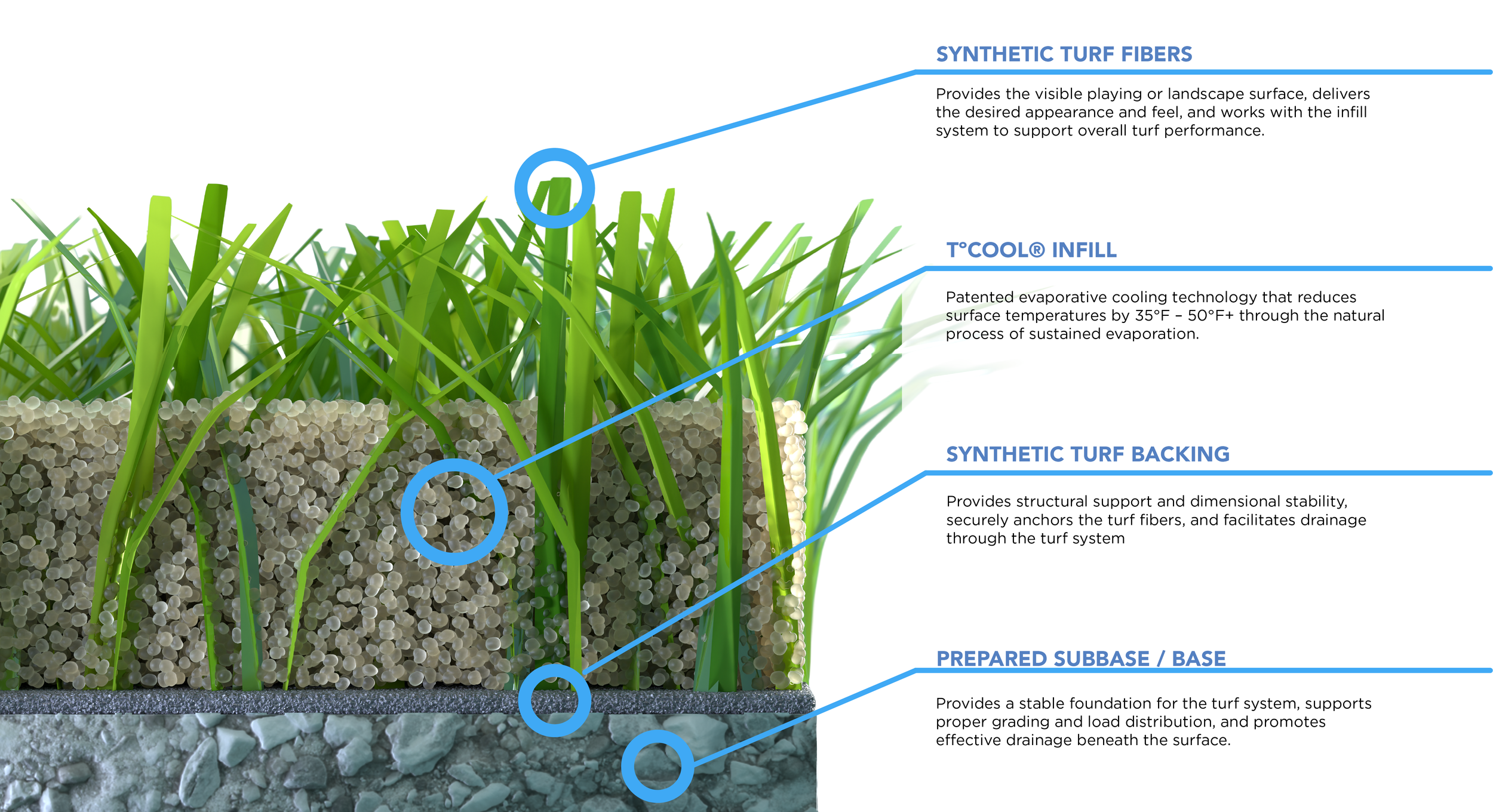
A properly designed synthetic turf installation consists of several key components: turf fibers, infill, backing, and a prepared base or subbase. Each layer serves a distinct purpose, contributing to how the turf looks, feels, drains, performs, and holds up over time.
TºCool® takes this system a step further by transforming the traditional infill layer into an active cooling component. Through its patented technology, TºCool harnesses moisture from rainfall, irrigation, and humidity to deliver sustained evaporative cooling throughout the turf system. Supplemental irrigation can help maintain optimal cooling performance during extended dry periods.
Understanding how these layers work together highlights the importance of proper infill depth, hydration, drainage, and installation—and how TºCool adds an essential cooling function to the synthetic turf system.
The Synthetic Turf System
Synthetic Turf Fibers
The turf fibers are the visible, grass-like portion of the synthetic turf system.
They create the finished surface and help determine the appearance, feel, resilience, and overall character of the turf. Depending on the application, turf fibers can vary in pile height, density, shape, stiffness, and construction.
Landscape turf may prioritize softness and natural appearance, while sports turf may place greater emphasis on footing, resilience, durability, and repeated use.
In simple terms, the fibers provide the usable surface of the turf system and work together with the integrated infill to help support overall performance.
Infill
Infill is installed between the synthetic turf fibers and fills the space above the turf backing.
Its role can vary depending on the material and the turf system. In general, infill helps support the fibers and contributes to the performance characteristics of the finished surface.
With TºCool®, the turf system’s functionality is complete as it adds the cooling component of the turf system.
TºCool is a patented synthetic turf cooling technology that works through evaporative cooling. Moisture stored within the infill matrix is gradually released as the turf heats, helping reduce synthetic turf system temperatures by approximately 35°F to 50°F+. TºCool consists of a 16/30 mesh, light brown or buff silica sand composed of approximately 99.5% silicon dioxide, enhanced with TºCool's patented cooling coating and chitosan, a naturally derived material recognized for its antimicrobial properties.
Turf Backing
The turf backing is the structural foundation of the synthetic turf carpet.
It helps secure the turf fibers in place, maintain dimensional stability, and provide the strength needed during installation and use. Backing systems also play an important role in drainage by allowing water to move vertically through the turf system.
A concise way to describe its role is: The turf backing provides structural support and dimensional stability, securely anchors the turf fibers, and facilitates drainage through the turf system.
Prepared Base and Subbase
Beneath the turf backing lies the prepared base and subbase, which provide a stable foundation for the entire synthetic turf installation. These layers support proper grading, load distribution, surface stability, and drainage.
Effective drainage is essential throughout the entire turf system. While high-quality synthetic turf is designed to facilitate vertical drainage, the base and subbase must also allow water to move freely through the system.
A properly designed and installed base helps maintain long-term surface stability, promotes efficient drainage, and prevents water from accumulating beneath the turf.
Why Infill Depth Matters
The depth of the infill matrix is an important part of TºCool system design.
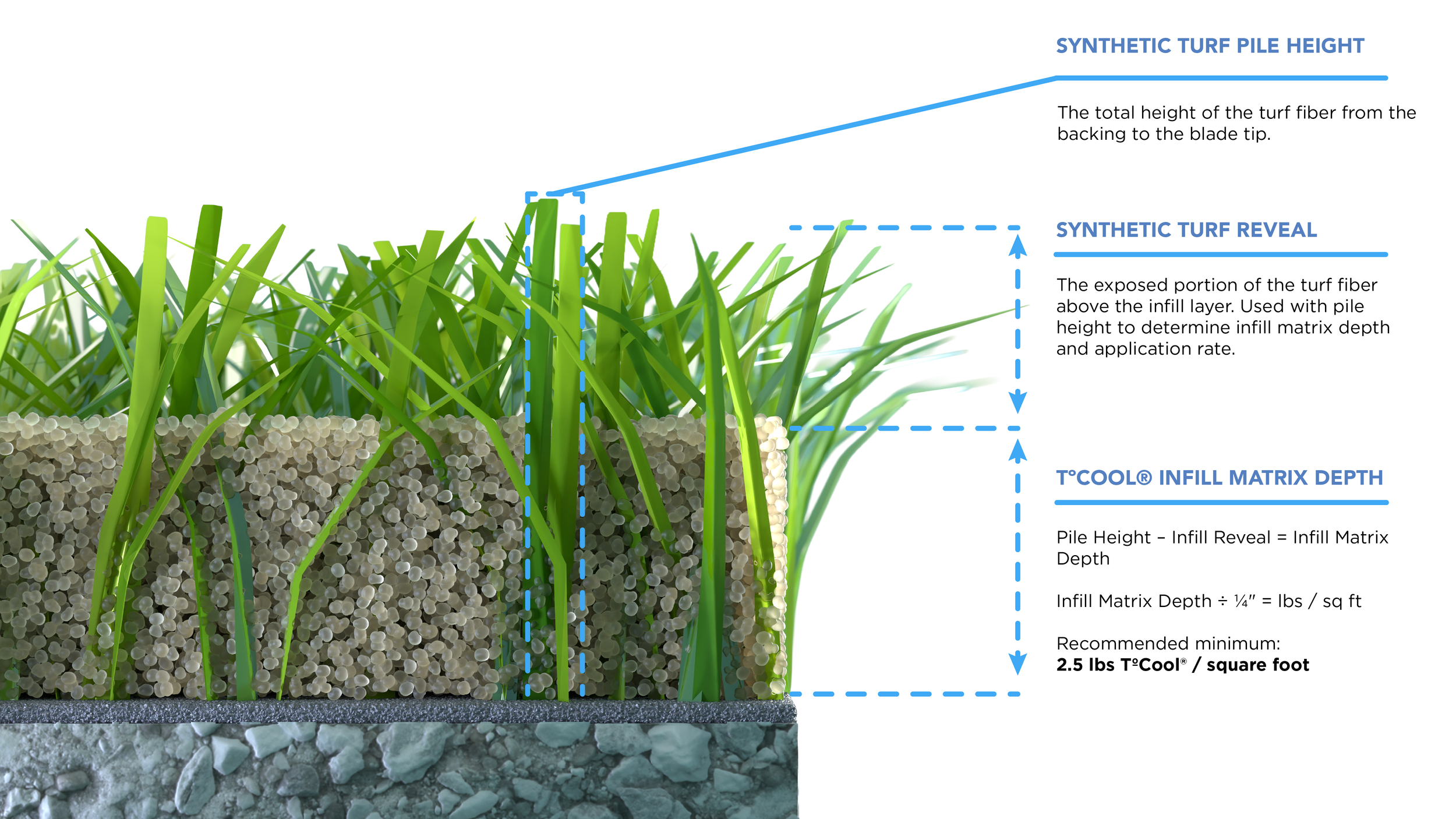
Two measurements help determine the appropriate application rate and depth of the infill matrix: pile height and infill reveal.
Pile height is the total height of the turf fiber measured from the backing to the tip of the blade.
Infill reveal is the portion of the turf fiber that remains exposed above the top of the infill layer. A typical Infill reveal is 3/8".
Infill Matrix / Application Rate Calculation:
Turf Blade Pile Height - Infill Reveal = Infill Matrix Depth
TºCool’s application formula then uses the infill matrix depth to estimate pounds per square foot:
Infill Matrix Depth ÷ 1/4" = ________ lbs. per Square Foot
For sustained cooling performance, TºCool® recommends a minimum application rate of 2.5 lbs per square foot. To determine the optimal application rate for your project, visit our TºCool Project Calculator.
The correct application rate is very important and should be based on the specific turf system as opposed to using the same amount of infill for every project.
TºCool Infill - The Cooling Process
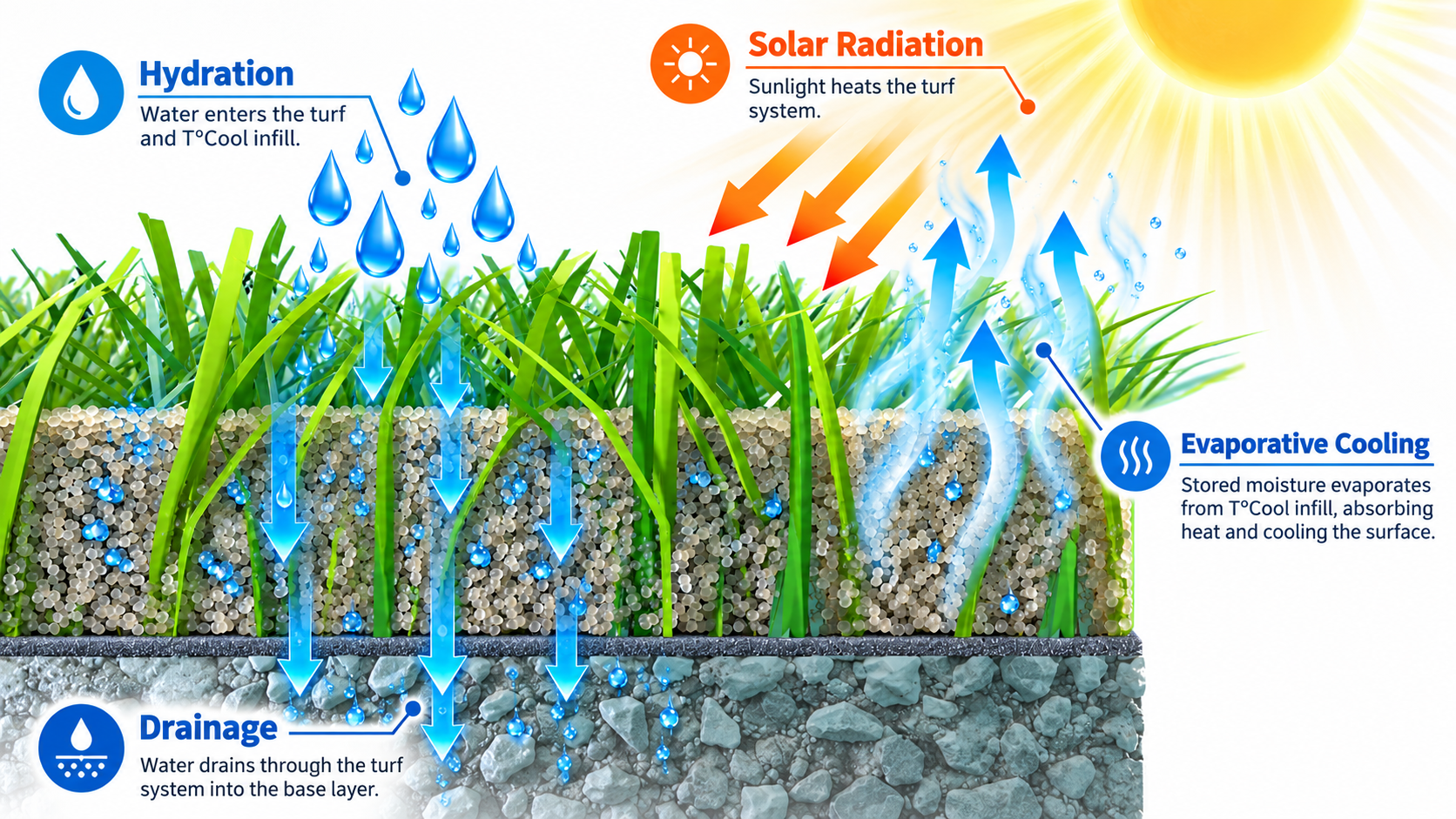
TºCool’s cooling process can be understood in three simple stages:
Hydration
Solar heating
Sustained evaporative cooling
1. Hydrate + Charge TºCool®
Moisture is what powers the TºCool cooling process.
Once installed, TºCool can collect moisture from rainfall, irrigation, humidity, dew, or manual watering. That moisture is stored within the infill matrix and becomes the reservoir used for evaporative cooling. GettingTheMostFromT°Cool.26
TºCool’s technical information notes that the TºCool infill matrix can hold roughly 0.36 gallons, or approximately 3 pounds of water, per square foot. GettingTheMostFromT°Cool.26
The goal is not simply to wet the surface temporarily, as occurs with traditional synthetic turf systems. Instead, hydration allows TºCool infill to absorb and retain moisture within the turf system, making it available for sustained evaporative cooling as environmental conditions drive evaporation.
In dry climates or during extended periods without rainfall, irrigation or manual watering can be used to replenish that moisture.
2. Sunlight / Solar Energy Heats the Turf
Synthetic turf exposed to sunlight absorbs solar energy, which causes the surface and surrounding turf system to heat.
As the turf warms, the moisture stored within the TºCool infill becomes available for evaporation.
This is where TºCool differs from simply spraying water onto a hot surface. The system is designed to hold moisture within the infill matrix so that the cooling process can continue as heat builds over time.
In other words, solar energy creates the heat load, while the hydrated TºCool infill provides the moisture needed to counteract that heat through evaporation.
3. Sustained Evaporative Cooling
As the turf surface heats, moisture stored within the TºCool infill gradually evaporates.
That evaporation removes heat from the turf system and helps reduce surface temperatures.
According to TºCool technical guidance, evaporation removes approximately 450 calories of heat energy per gram of water evaporated. GettingTheMostFromT°Cool.26
Because TºCool is engineered to retain and manage moisture within the infill matrix, the cooling effect can continue beyond the initial hydration event.
That is the key idea behind sustained evaporative cooling.
TºCool stores moisture within the turf system and gradually releases it as the surface heats. As that moisture evaporates, heat energy is transformed removed from the turf, helping keep the synthetic turf surface cooler for longer after hydration.
Completing the Synthetic Turf System with TºCool®
Each component of a synthetic turf system serves a distinct purpose. The fibers create the playing surface, the backing provides structure, and the base supports stability and drainage.
TºCool takes the system a step further by transforming the infill layer into an active cooling component. Through its ability to absorb, retain, and release moisture, TºCool introduces evaporative cooling directly within the turf profile—providing a function that traditional synthetic turf systems lack.
When incorporated into a properly designed and installed turf system, TºCool does more than enhance performance. It adds an essential cooling function, helping create a more comfortable and functional surface.
Understanding the anatomy of synthetic turf helps illustrate where TºCool fits within the system—and how its cooling technology elevates the performance of the entire surface.